The risk in an AI-first trial is not that teams use the tools. It is that they defer to them without the comprehension to know when the tool is wrong.
In the span of a few weeks this spring, the FDA made its direction unmistakable. The agency launched two proof-of-concept real-time clinical trials that stream data to regulators as it is generated, expanded its internal AI platform so that AI now sits on top of its review infrastructure, and published an expanding set of channels for sponsors to engage on the use of AI across trial design and conduct. The regulator is industrializing AI across the lifecycle, and faster than most sponsors expected.
The industry response has been loud and largely uniform. Every conference agenda and vendor booth now carries a version of the same promise: adopt the right AI, and the hard parts of running a trial get easier for everyone. In an environment where sponsors traditionally expect different levels of site performance, the implicit assumption is that AI is a leveler, that better tooling will narrow the distance between a site that executes well and one that struggles.
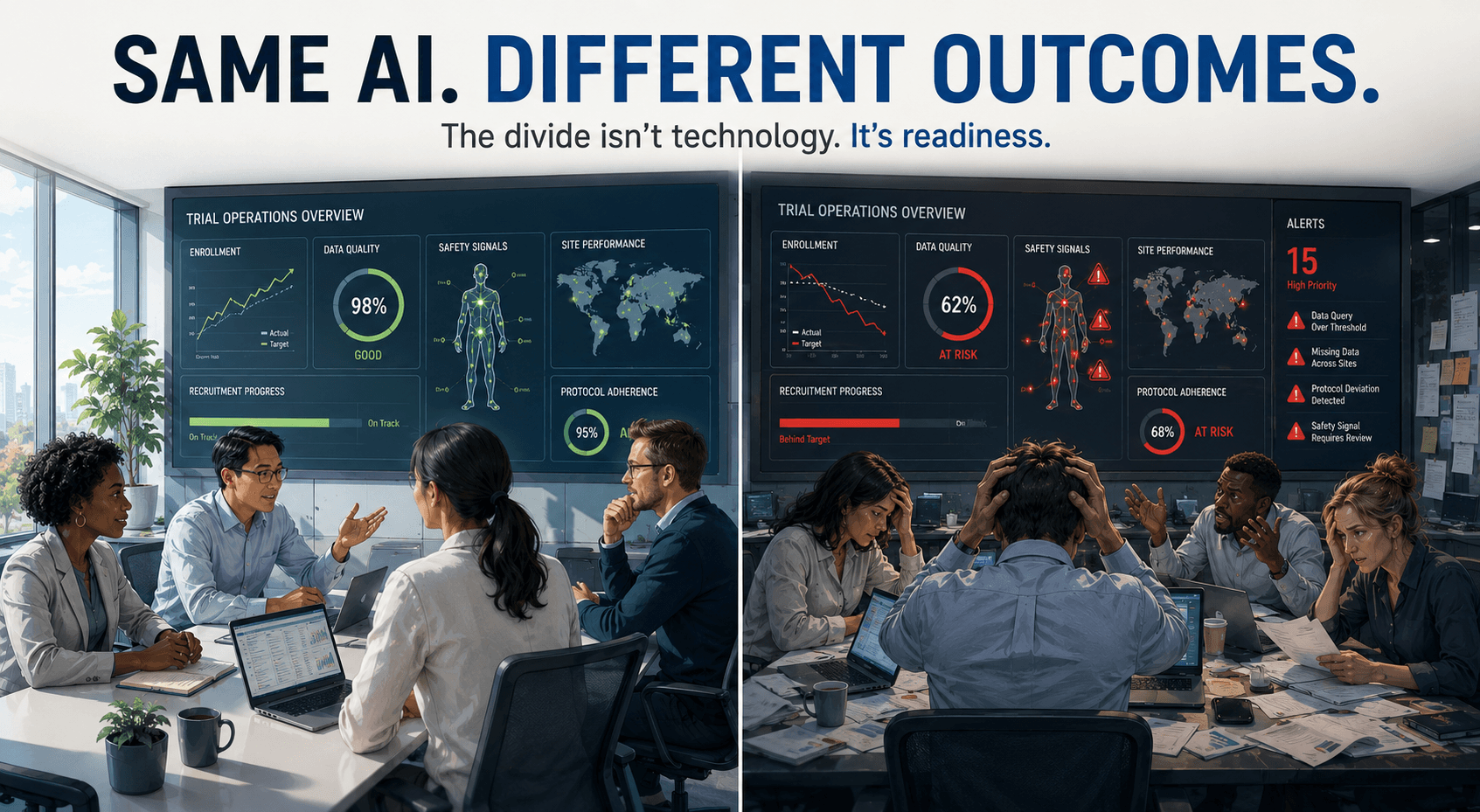
I want to challenge that assumption directly. AI is not a magic wand that can be waved around and instantly improve site performance. Applied to the work of running a trial, it more likely widens the distance between teams that are ready to execute a protocol and teams that are not.
The gap is already here, and it is measurable
This is not a hypothetical divide. The evidence that site teams enter studies with very different levels of readiness is already well documented. WCG’s 2026 Clinical Research Trends Report found that nearly half of sites say protocol complexity and tool overload are already limiting their ability to take on new studies. Research from the Tufts Center for the Study of Drug Development identified protocol interpretation as one of the most significant and least examined bottlenecks in study startup, the moment a team reads a protocol and tries to translate it into action. What happens when the sites that are already struggling to understand complex protocols are expected to execute at an even faster rate as powerful automation tools are deployed on their studies?
Why automation widens the distance
AI can streamline workflows but it does not run a clinical trial. People do. AI drafts, summarizes, and surfaces, but a coordinator still interprets the protocol, an investigator still makes the eligibility call, and a human still prepares the source documentation under pressure. AI can change the speed of the work around those people, but it does not magically erase the different levels of comprehension and confidence between teams. It magnifies them. A team that genuinely understands the protocol and is confident in executing the study moves faster, because the tooling removes friction. A team that has not mastered the protocol makes its errors faster when using AI, at greater scale, and with the AI lending those errors a false sense of confidence.
This hazard has a name. Behavioral scientists call it cognitive surrender. When a capable tool is available, the path of least resistance is to defer to it. To accept the AI’s draft, its summary, its flagged signal, without the knowledge to judge whether it is right. A team with deep protocol comprehension uses AI and stays in command of the work. A team without that comprehension surrenders to the tool, and in an AI-first trial that surrender is a recipe for failure no RBQM dashboard can flag and prevent on their behalf. Readiness is the antidote. It is what lets a person use a powerful tool without abdicating judgment to it.
AI compresses most timelines in a trial except the one that matters most. It cannot accelerate the time it takes a person to genuinely understand what a complex protocol requires.
Real-time oversight removes the cover where gaps used to hide
Gaps in a site’s readiness are slow to surface in traditional trials. A misunderstood inclusion criterion, or a confidence that outran comprehension, might not produce a visible consequence for weeks, working its way quietly through screening and into the data before a monitoring visit caught it.
The FDA’s initiative for real-time oversight removes that latency. When data streams to a sponsor and a regulator as it is generated, the distance between a performance gap and its visible consequence collapses toward zero. The gap that used to stay hidden now appears almost immediately, and in front of an audience that now includes the FDA. The underlying readiness problem at that site has not changed. What has changed is that there is nowhere left for it to hide, and the teams that were never genuinely ready are the ones newly exposed.
The variable no one is measuring
Here is the uncomfortable implication for leaders being pitched on AI. You can deploy the most capable tools in the market and still widen the gap inside your own programs, because those tools assume a level of human readiness that you are not measuring yet and therefore cannot guarantee. The performance risk does not live in the technology. It lives in the people using it.
This is where one distinction has to be made cleanly. Completing training is not the same as being ready to execute a protocol or use a new tool. And checking the box on the training report, on its own, tells you nothing. In too many cases it provides the sponsor a false sense of comfort that is not calibrated to actual comprehension and eventual team performance. A coordinator who acknowledges they read the protocol is not the same as one who understands it and can apply it accurately under the pressure of a screening visit. The variable that matters is whether a team’s confidence is matched by their demonstrated understanding, and most sponsors have no method to measure it.
Under ICH E6(R3), now adopted by the FDA and in active implementation, this is no longer only an operational concern. The guideline expects sponsors to ensure study personnel are qualified commensurate with their tasks. Not that they completed a training module. It mandates that they are actually able to do the work. The regulatory standard for determining that a site is ready has moved higher. The question is whether the methods sponsors use to assess readiness have moved with it.
The real question for the year ahead
The leaders getting this right are not the ones with the longest list of AI pilots. It’s those that treat human readiness as the precondition for any tool to be used correctly, and they measure it before a site is activated rather than assuming it. They assess how confidently and accurately a team can demonstrate they are prepared to execute the protocol, weeks before the first patient enrolls, and can intervene far earlier before once preventable risks manifest into deviations and delays downstream. The value any sponsor gets from its new AI tools rises or falls with how well its teams can use them during study execution.
So the question I would pose to anyone shaping an AI strategy right now is simple. You are most likely investing in tools that move trials faster than your teams can currently comprehend or execute effectively. How are you measuring whether the people running your trials are ready to command those tools and the protocol, rather than surrender to them?
Joel Selzer is Co-Founder and CEO of ArcheMedX, a clinical trial readiness intelligence company. He writes on human performance and execution risk in clinical research.
Related Post
The Earliest Warning Sign: How Measuring Readiness at Training Predicts Trial Risk Before It Shows Up in the Data
Most protocol deviations start as human problems, not operational ones, but risk-based monitoring typically relies…

Brian S McGowan, PhD
Fresh Starts, Real Readiness: Turning Site Initiation into a Trial Success Multiplier
By leveraging the Fresh Start Effect at site initiation and shifting from passive training to…
Brian S McGowan, PhD
The Confidence Trap in Clinical Trials: When Knowing Just Enough Becomes Dangerous
Ways to identify false certainty, or "errogance," during the clinical site start-up-to-launch process—and better ensure…